
Disaster risk reduction must include persons with disabilities. Our new regional assessment shows how far Southern Africa still has to go.
Zonge Research International has completed a comprehensive regional assessment examining disability-inclusive disaster risk reduction (DiDRR) implementation in Zambia and Zimbabwe. The work was commissioned by the Southern Africa Federation of the Disabled (SAFOD) and conducted under the team leadership of Dr Paliani Chinguwo.
The assessment draws on field research in both countries, interviews with government officials, civil society organisations, and organisations of persons with disabilities (OPDs), plus focus group discussions with persons with disabilities themselves. Findings are triangulated with the 2023 SAFOD Baseline Study and regional policy framework analysis.
What We Found
The central finding is consistent across both countries: policy frameworks exist, but practice lags far behind.
Both Zambia and Zimbabwe have signed the Sendai Framework for Disaster Risk Reduction. Both are parties to the UN Convention on the Rights of Persons with Disabilities. Zimbabwe has a National Disability Policy that explicitly requires disability inclusion in disaster planning. Yet in both countries, persons with disabilities remain systematically excluded from disaster risk reduction systems.
Early warning systems are not accessible. Evacuation shelters are not accessible. Disaster response budgets have no dedicated funding for disability-inclusive approaches. Data on how disasters affect persons with disabilities does not exist. Persons with disabilities are not represented in disaster management decision-making structures.
This is not a problem of absent frameworks. It is a problem of implementation.
The Human Cost
Persons with disabilities face disaster mortality rates two to four times higher than the general population. They cannot access warnings. They cannot evacuate safely. Relief supplies do not reach them. Recovery programmes exclude them.
Women with disabilities face even greater risks, facing compounded exclusion in disaster contexts.
Key Findings Across the Four Sendai Priorities
Priority 1 – Understanding Disaster Risk. Disaster risk data systems are weak and fragmented. Disability-disaggregated data is absent in both countries. Participation of persons with disabilities in risk assessment is minimal or inconsistent.
Priority 2 – Strengthening Disaster Risk Governance. Policy frameworks exist but implementation is weak. OPDs are consulted but have no decision-making power. Persons with disabilities hold zero representation on disaster management committees.
Priority 3 – Investing in Disaster Risk Reduction. Neither country has dedicated budget lines for DiDRR. Funding is reactive rather than preventive. Both countries depend heavily on external funding for disaster response.
Priority 4 – Enhancing Disaster Preparedness and Build Back Better. Early warning systems rely on SMS and radio but are not available in sign language, Braille, or simplified formats. Evacuation routes and shelters are not accessible. Build Back Better is the weakest area, with no systematic disability accessibility requirements in recovery programming.
What Must Change
The assessment provides evidence-based recommendations for governments, OPDs, and regional bodies:
- Establish formal OPD representation in disaster management decision-making structures.
- Mandate disability-disaggregated data collection in all disaster loss reporting.
- Allocate dedicated budget lines for DiDRR at national and sub-national levels.
- Make early warning systems accessible through sign language interpretation, captions, and audio formats.
- Integrate accessibility standards into all Build Back Better programming.
- Strengthen capacity at district and community levels for inclusive disaster risk reduction.
The Regional Context
Both Zambia and Zimbabwe are landlocked developing countries facing similar disaster risks: drought, floods, disease outbreaks, and the cascading impacts of climate variability. Both have active OPD networks but face resource constraints. Both experience a critical gap between national policy and local practice.
Yet both countries also show pockets of progress. ZAFOD’s engagement with Zambia’s Disaster Management and Mitigation Unit demonstrates potential for institutional change. Zimbabwe’s National Disability Policy 2021 provides a strong normative foundation. FODPZ has proven its capacity to engage effectively in policy dialogue.
These examples prove that change is possible. The problem is not impossibility. The problem is priority.
What Happens Next
The consolidated regional report and policy briefs have been submitted to SAFOD for advocacy going forward. SAFOD will use this evidence to engage governments, SADC, and development partners on disability-inclusive disaster risk reduction.
The assessment confirms that ten years after the Sendai Framework was adopted, the gap between policy and practice remains wide. The next five years are critical. Without urgent action, persons with disabilities will continue to face disproportionate disaster risks.
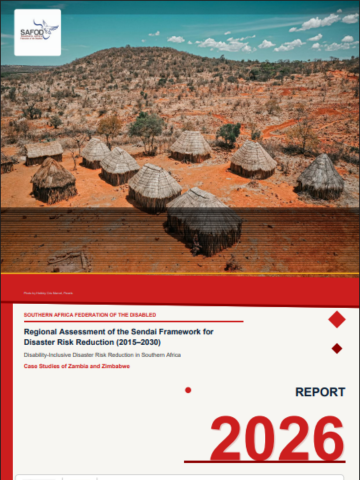
SAFOD Regional Assessment
Sendai Framework Implementation: Zambia and Zimbabwe Case Studies
Download Report (PDF)About This Work
This regional assessment was conducted by Zonge Research International on behalf of SAFOD, with support from Christian Blind Mission.
The work builds on the 2023 SAFOD Baseline Study and Mapping Exercise, which established the initial evidence base for disability-inclusive DRR in Zambia, Zimbabwe, and Malawi.
Zonge Research International specialises in research that informs policy and advocacy on disability, development, and disaster risk reduction in Southern Africa.
We work with governments, civil society, and disabled people’s organisations to strengthen evidence-based decision-making.
You can learn more about the findings by downloading the full report published on the official website of the SAFOD (click the button on the left).
Key Terms:
Disaster risk reduction. Sendai Framework. Disability inclusion. Zambia. Zimbabwe. Southern Africa. Disaster preparedness. Early warning systems. Build Back Better.